Most AI shopping apps help you buy more.
Almost none help you wear what you already own.
Shopping apps are optimized for the purchase moment. But the highest-frequency, highest-emotion moment in fashion isn't buying — it's getting dressed at 7am. That moment happens 365 times a year. Shopping happens maybe 40.
Every app is built for the 40. No one has built for the 365.
Your closet, but useful. A morning decision engine that knows what you own, what the weather demands, and where you're going — then tells you exactly what to wear in under 10 seconds.
The post-purchase dead zone.
Apps win at checkout, then disappear. What remains is a closet full of clothes and no system for using them. Three compounding failures:
-
01
Information failure
Users don't know what they have. Things live in the back of the wardrobe, forgotten. No visibility, no decisions.
-
02
Memory failure
People impulse-buy duplicates of items they already own. No moment of friction between "I want this" and "I'll buy this."
-
03
Follow-through failure
Items sit unworn past their resale window. When they finally let go, the item has depreciated and the financial recovery is minimal. Billions in sellable clothing ends up donated at a fraction of its value.
The result: 20 minutes of morning indecision, guilt about unworn items, a wardrobe that costs more than it earns. This is not a style problem. It's a systems problem.
A proactive wardrobe agent.
Three stages, one connected system. Each stage feeds the next.
Morning outfit based on live weather + inventory + learned preferences. One concrete answer. Two alternatives. Not a gallery to scroll through — a decision already made for you.
CPW visibility and gap detection. Before you buy, Kairo surfaces: "You already own 3 black blazers." The data creates the friction. Friction changes behavior.
Depreciation tracking and resale alerts before value collapses. The agent gives you a number and a window. Sell now, recover value, clear space.
Each loop makes the next one tighter. This is not a feature. It's a compounding flywheel.
"Get Ready" — the morning decision engine.
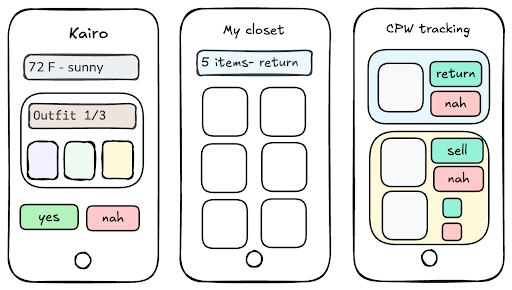
Instead of "72°F, 45% humidity," Kairo says: "Warm but breezy — light layers perfect." Human language, not weather data.
Single best outfit in under 2 seconds. No scrolling. No decisions. Designed for the half-asleep 7am brain.
"Worn 2 days ago" (red), "Worn 5 days ago" (green), "New — never worn!" (blue). Wear history on every card.
Items unworn for 90 days surface in a carousel. Two actions: Style It or Sell It. No guilt. Just a decision.
Swaps one piece at a time to surface unseen combinations. Same trousers, different top.
Cost-per-wear visibility per item. Depreciation alerts before the resale window closes.
My role. The agent loop. Zero-decision UI.
My role: Led product strategy end-to-end. Designed the agent architecture, built the functional prototype, defined the interaction model.
Zero-decision UI: 56px+ touch targets. Binary choices only. No dropdowns, no sliders — because the product lives at 7am.
Two users. One shared motivation: feel in control without extra effort.
Time-poor. Frustrated by morning decision fatigue. Quietly aware their wardrobe isn't working as hard as it should. They want confidence, speed, and the feeling of making good decisions — without becoming a fashion expert.
Approach their wardrobe like any other asset: with an expectation of return. CPW trends, depreciation visibility, resale timing. Likely to become vocal advocates once the data layer has depth.
What already exists — and why it all misses the mark.
| App | Users | What It Does | The Gap |
|---|---|---|---|
| Acloset | 7M+ | AI stylist, weather + schedule outfit picks, style stats, body/color analysis | Feature-rich, agent-poor. Reactive, not proactive. |
| Phia | B2B/Consumer | Post-purchase intelligence, wardrobe tracking, brand integrations | Data aggregator for brands, not a decision agent for users. |
| Alta | Growing | Daily outfit suggestions, weather, CPW tracking, avatar try-on | Digital twin, not daily decision agent. |
| StylistIQ | Newer | Claims proactive morning notifications, ML learning, anchor-item logic | Partially closes the gap but early stage. |
| Cladwell | Niche | Daily suggestions, wardrobe analytics, sustainability focus | Capsule wardrobe only, limited scale. |
| Fits | Social | AI outfit planner + virtual try-on + community | Social-first, not decision-first. |
The white space is not more features. It's autonomous action.
Most of these apps are AI-powered. You open them, tap a button, and they suggest something. Phia and Alta are the ones moving meaningfully toward agentic commerce. That makes them the most interesting integration opportunity.
Here is how I would extend Kairo into each if I were a PM.
- 01 Standalone Phia, the AI shopping app, already owns the pre-purchase moment by helping users compare, evaluate, and buy more intentionally.
- 02 Integrated with Kairo A wardrobe agent turns a one-time shopping session into a daily habit loop. Users wear what they own, buy with more intention, and resell at the right time. Phia moves from price-comparison tool to full shopping intelligence layer, stronger for retention, sustainability, and long-term value.
- 01 Standalone Alta, the agentic styling app, is strongest when it helps users decide what to wear today — and becomes even more powerful when it extends into the full wardrobe lifecycle.
- 02 Integrated with Kairo As part of a broader wardrobe system, Alta can influence what users buy, how often they wear it, and when to let it go. That moves the product from styling to full wardrobe decision-making, more habit-forming and more defensible.
The case in three lines.
The wardrobe is the largest unmanaged asset class in daily life. No system connects wearing, buying, and selling into one intelligent loop. The gap is structural, not cosmetic.
AI decision support is normal. Consumer behavior is ready. The secondhand market is projected at $350B by 2028. Infrastructure is here, the gap is open.
PERCEIVE (weather + closet) → REASON (GPT-4o) → ACT (push outfit) → REFLECT (update on confirm/skip). Not a chatbot. An agent that acts on your behalf.
Four questions that determine whether this has legs.
DAU/MAU lift from episodic to daily. Does the morning recommendation create a genuine habit, or do users open once and forget about it by day three?
Outfit confirmation rate. Are users actually wearing what Kairo suggests? This is the single most honest signal of whether the recommendation engine is earning trust.
Do wardrobe-aware shopping recommendations convert at a higher rate than generic ones? This is the business case in a single metric.
Qualitative validation of the core assumption. Do real users experience the 7am problem the way I think they do? What does the decision moment actually look like?